A damaged product can undo a lot of earned goodwill between your organization and its customer base. Choosing the right type of foam packaging material can help protect products from damage while staying within budget. If your business understands the benefits and limits of each option, you can reduce shipping damage and protect your reputation.
The 4 Types of Foam Packaging
There are four main types of foam packaging materials, not including specialized foams. Density, applications, chemical resistance and durability are common priorities for organizations looking to protect their products. Choosing the right one depends on your specific packaging needs, as each material has its own strengths and best-fit circumstances.
1. Polyethylene (PE) Foam
Polyethylene (PE) foam materials are effective at protecting delicate items. They are noted for:
-
Significant shock-absorbing capabilities, which help cushion products against impacts during transit and handling.
-
Good resistance to moisture and many common chemicals.
-
Flexibility to conform closely to product shapes for a secure fit.
While versatile, PE foam generally doesn’t offer strong soundproofing to minimize vibrations. Its properties can be affected by prolonged UV exposure, leading to degradation over time.
2. Polyurethane (PU) Foam
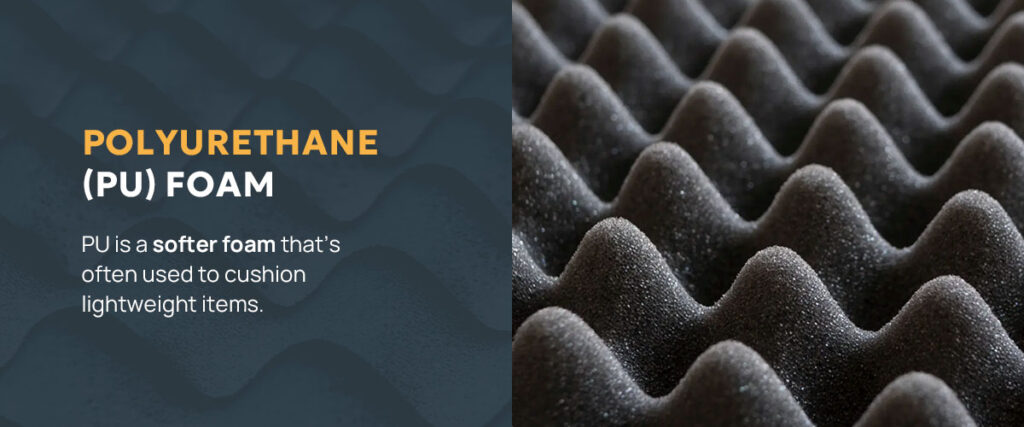
PU is a softer foam that’s often used to cushion lightweight items. Other benefits include:
-
Its ability to conform to an object’s shape makes it a good option for presentation purposes.
-
PU can provide a degree of thermal insulation and resistance to some chemicals.
One drawback of this foam type is that it offers lower structural support than other types of packing foam.
3. Expanded Polystyrene (EPS) Foam
While specifics vary depending on the type of products being protected, the main features of EPS foam include:
-
A lightweight, closed-cell foam material that’s made up of about 98% air.
-
High impact resistance and shock absorption.
-
Stable thermal insulation.
-
The ability to fit into products with precision.
This foam material is commonly used for blocking and bracing in single-use shipping applications.
4. Expanded Polypropylene (EPP) Foam
EPP foam packaging is a high-performance material known for its resilience and durability. This material can absorb repeated impact and still return to its original shape. These benefits make EPP foam a good potential choice for multi-impact cushioning.
Other EPP foam packaging benefits include:
-
A high buoyancy and chemical resistance.
-
Stable dimensions under repeated stress and degradation.
-
A recyclable material with potential for recycled-content use.
-
The ability to protect products through several transport cycles.
How to Choose the Right Foam for Your Application
The right types of foam for packaging your products depend on the kind of items you want to protect. Making the best choice for your specific needs can reduce problems related to impact, shock, compression and temperature changes.
While one of the four main packaging foam types will support most product needs, some more challenging standards may require a more specialized foam.
Product Fragility
Open-cell foam — such as PU — is like a sponge, offering softness and conformity. Closed-cell foams — like PE, EPS and EPP — are like a collection of sealed bubbles, offering rigidity and moisture resistance. You should typically choose an open-cell (PU) foam for fragile items with priorities like:
-
Gentle cushioning
-
Vibration dampening
-
Conformity to irregular shapes
Closed-cell foams (PE, EPS, EPP) are generally preferred for fragile applications demanding:
-
Superior impact absorption
-
Structural support
-
Robustness
Shock Absorption
The ability to absorb shock varies significantly among foam packaging types, with multi-impact resilience being a key differentiator. EPP works well in multi-impact scenarios, repeatedly deforming and recovering its shape. It’s often ideal for reusable packaging.
EPS acts more like a “crumple zone,” absorbing a single major impact by permanently deforming. This distinction is important to know when comparing the benefits of disposable and long-term reusable packaging solutions.
Thermal Insulation
R-value defines a material’s thermal resistance and indicates a foam’s effectiveness as an insulator. In packaging, a high R-value signifies superior thermal insulation, helping maintain stable temperatures during transit. Materials like EPS foam packaging are known for their high R-value. They are often well-suited for temperature-sensitive shipments, such as pharmaceuticals or perishable goods.
Reusability
When designing packaging for multiple uses, understanding each foam type’s ability to withstand repeated stress is crucial:
- EPP foam: This foam packaging is known for its multi-impact resistance. It can usually withstand repeated shocks and often recovers well across many transport cycles.
- EPE foam: EPE also offers good multi-impact resistance and flexibility, making it a viable option for delicate electronics, glassware or returnable dunnage.
- EPS foam: EPS foam packaging is recyclable but typically deforms after absorbing significant impact, limiting its reusability.
- PU foam: This foam can be reused if it retains structural integrity and cushioning properties. Its durability will depend heavily on density and cell structure.
Chemical Resistance
Polyethylene (PE) and Expanded Polypropylene (EPP) foams are generally resistant to most common chemicals, oils and solvents. Expanded Polystyrene (EPS) also offers good chemical resistance but can be susceptible to damage from aggressive solvents like acetone.
The chemical resistance of Polyurethane (PU) foams can vary widely depending on their formulation. Typical cushioning grades are generally less resistant to acids, bases or organic solvents than PE or EPP.
Fire Resistance
Most standard foam materials are combustible to some degree. EPS and PU formulations can be fire-treated to enhance retardant performance and achieve specific fire ratings. For industries where fire safety is a priority, specialized, fire-resistant foams are available.
Budget
EPS foam is often considered an economical choice, particularly for high-volume, single-use applications. PE foam can often provide good value through its versatility and protective qualities. EPP foam, recognized for its advanced manufacturing and performance attributes, is generally a premium option.
PU foam costs vary widely depending on density and formulations. Specialized fire-resistant or anti-static foam options incur higher costs due to their enhanced properties.
Our Engineered Packaging Solutions
General Packaging Corporation has over six decades of experience in providing customized packaging solutions. As a people-first business, we take the time to understand what you need to package, using it as the blueprint for our engineer-led design process. You’ll be given a prototype to check, and we only move forward when the design meets your expectations.
Once an order is placed, you’ll be assigned a dedicated customer service representative to provide production updates and answer queries. We run our own truck fleet, keeping delivery costs low and ensuring your choice of packaging arrives on time.
We take pride in creating custom foam packaging in our ISTA-certified lab, while maintaining our customer-first values. As a family-owned and operated business, it’s how we develop long-term, trusted relationships with our customers.
Flexible Order Volumes for Foam Packaging Materials
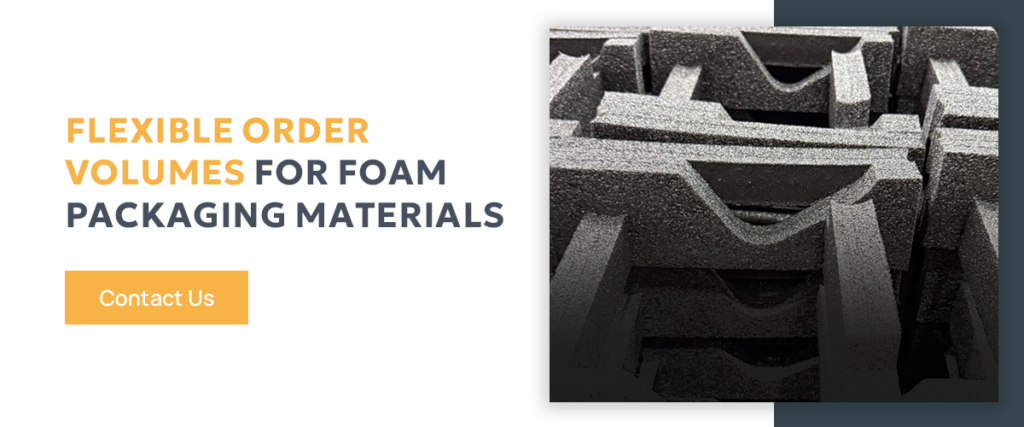
We partner with customers to provide long-term protection for goods. With fast response times and a focus on design and engineering excellence, we look beyond the quick-fix options to build trusted relationships. Your customized foam packaging will be specifically made for you.
You can even run smaller-volume orders if you don’t want to commit to full-truckload volumes. Contact us today for a personalized talk with a member of our team.