The foundational role of wooden pallets in modern logistics is underscored by a projected market value of $10.94 billion by 2034. To make informed decisions within this significant industry, effective pallet purchasing requires clear communication with suppliers about specifications. Each pallet comprises key components that affect handling compatibility and cost. Understanding these will help you evaluate quotes more accurately and select pallets that meet your operational needs. This guide provides a practical overview of wooden pallet parts.
The Core Components of a Wooden Pallet
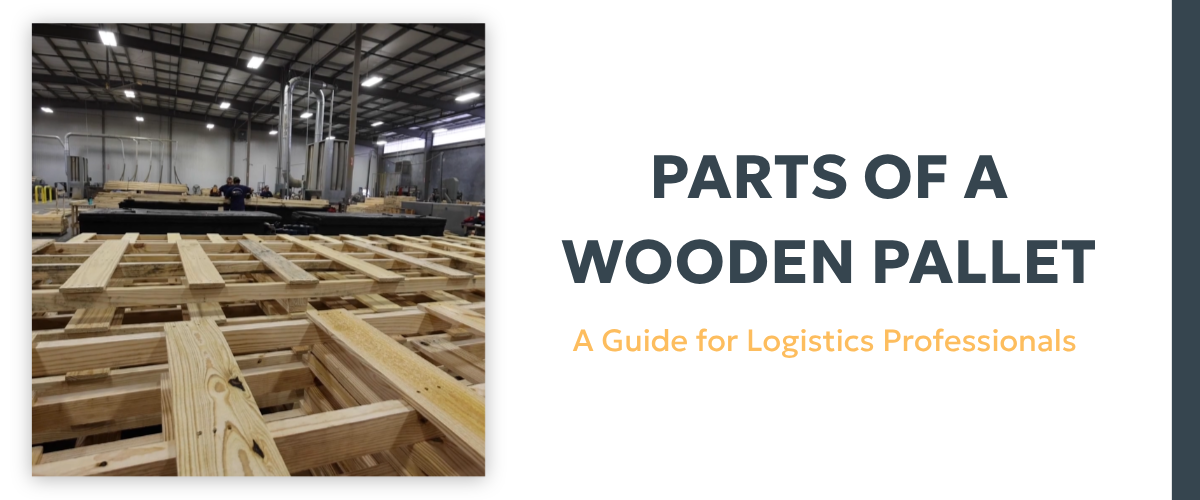
While pallet construction types can be customized, all wood pallets for packaging share these basic building blocks.
Top and Bottom Deck Boards
Deck boards form the flat surfaces of a pallet. They make direct contact with the product inside, while the bottom deck boards rest on the ground and forklift forks during handling. These boards distribute weight evenly across the pallet structure.
Most pallets feature wider boards at the outer edges, called lead boards, which provide added stability where loads are most likely to shift. The narrower inner boards fill the space between the lead boards.
The bottom deck boards can be arranged in various ways:
- Unidirectional: All the boards are oriented in the same direction, such as all running parallel to the pallet’s width. This provides foundational stability for general use.
- Perimeter: The boards are arranged to form a continuous frame around the entire base of the pallet. This design significantly increases rigidity and is critical for ensuring stability when the pallet is stored in warehouse racking systems.
- Cross-decked: This is an even stronger full-bottom design where boards are placed running in multiple directions — often perpendicular to each other — to create a highly dense and robust bottom surface.
- Cruciform: This typically starts with a perimeter frame and adds more boards that form a cross, or “crux”, in the center of the base. It provides the highest level of structural rigidity and is used for very heavy or sensitive loads that must not bend.
Stringers and Notches
Stringers are the solid wood beams that run lengthwise under the deck boards. They form the structural backbone of the pallet and transfer load weight to the ground or storage rack. In a standard stringer pallet, three stringers typically provide support along the length of the platform.
Notches are the cutouts shaped into the stringers that create openings for forklift tines. When stringers include notches on two sides, you can lift the pallet from four directions instead of just two. This flexibility speeds up warehouse operations and gives you more positioning options in tight spaces.
Blocks
Blocks are solid wood columns used in place of stringers in certain pallets. They provide exceptional strength and allow full access from all directions.
This pallet design typically uses nine blocks arranged in a grid pattern to support the deck boards. The blocks sit between the top and bottom decks, creating a four-way entry from any side or end. The number of blocks in a pallet can vary based on load requirements. Heavy-duty applications may require additional support points.
Fasteners
Fasteners secure the deck boards to the stringers or blocks and include nails, screws, staples and bolts.
Most pallets use nails or staples for assembly because they offer reliable holding strength at a lower cost than screws or bolts. Nails work well for standard applications, while staples can speed up manufacturing. Screws and bolts appear in specialized applications where you need the ability to disassemble and repair the pallet. Bolts are typically reserved for heavy-duty custom crates or situations where you need to secure loads directly to the pallet structure.
Proper fastener placement directly affects pallet performance. According to the Uniform Standard for Wood Pallets published by the National Wood Pallet & Container Association (NWPCA), fasteners should be positioned to minimize wood splitting. Staple crowns should run perpendicular to the wood grain, and manufacturers should avoid driving fasteners into end grain whenever possible.
Pallet Construction: Stringer vs. Block vs. Wing Pallets
These styles handle differently in your facility, offer different strength characteristics and come at different price points.
Stringer Pallets
When stringers have no notches, forklift operators can only enter from the two open ends, creating a two-way pallet. This simpler design uses less material and costs less to produce. Adding notches to the stringers transforms the design into a partial four-way pallet. Forklifts can now enter from the sides as well as the ends, giving your warehouse team more flexibility in handling and storage.
Block Pallets
Block pallets deliver superior durability and four-way access from any angle. The block arrangement creates multiple support points under the deck, distributing weight more evenly than stringers alone. This design handles heavy loads exceptionally well and withstands repeated use in demanding environments. Automated facilities particularly benefit from block pallets. Conveyor systems, automated guided vehicles and robotic handling equipment can approach block pallets from any direction.
Wing Pallets
Wing pallets feature deck boards that extend beyond the outer stringers or blocks, creating an overhang on two or all four sides. This extended surface area accommodates loads that are slightly larger than the pallet base or products with irregular shapes that need extra support at the edges. The extended deck provides a clean edge for film application, resulting in more secure loads. When you need to maximize usable surface area while maintaining standard forklift entry points, wing pallet designs are a practical solution.
How to Choose the Right Construction for Your Load
Your choice comes down to matching pallet design to your specific handling and load requirements.
- Stringer pallets efficiently meet general shipping needs and keep costs manageable for standard applications.
- Block pallets make sense for heavy products, frequent reuse cycles or facilities where four-way access improves throughput.
If standard options don’t quite fit your application, designing a custom pallet can address unique size, strength or handling requirements.
How Materials and Dimensions Affect Pallet Performance
The materials and dimensions you select determine how that pallet actually performs under real conditions. A well-built wooden pallet can often be reused 10-15 times, making these choices critical for long-term value.
Hardwood vs. Softwood
Hardwoods like oak provide higher density and greater resistance to impact damage. These characteristics make hardwood pallets ideal for heavy loads or applications where pallets will be handled roughly. Hardwood also resists moisture better than softer species, which matters in humid environments.
Softwoods like pine cost less and work well for lighter loads or single-use applications. Hardwood pallets for heavy-duty applications provide the strength needed for demanding shipping conditions, while softwood offers a cost-effective solution for moderate requirements.
Standard Pallet Dimensions
The 48-inch by 40-inch Grocery Manufacturers Association (GMA) pallet is one of the most widely recognized sizes in U.S. supply chains. Other common sizes serve specific regional and application needs. European pallets measure 39.37 inches by 47.24 inches and are also used throughout Asia. Australian pallets typically use a 45.9-inch by 45.9-inch square format that allows easy access from the front and back.
Choosing the right dimensions affects the efficiency of your entire supply chain. Wooden pallets that match your carrier’s equipment and your warehouse racking systems move faster through facilities and require less handling time. Non-standard sizes can increase shipping costs because they leave gaps in trailers or require custom handling procedures.
The Importance of Compliance for Shipping
Beyond selecting the right construction and dimensions, compliance requirements should also factor into your pallet decisions. The International Standards for Phytosanitary Measures (ISPM) 15 were designed to help prevent the spread of invasive pests through wood packaging. This regulation requires heat treatment of wood to specific temperatures and official marking with a certified stamp. Any pallet crossing international borders must meet this standard.
Start Your Packaging Solution With GPC
Understanding the parts of a pallet is the first step toward making smarter purchasing decisions. The next step is partnering with an experienced packaging provider who can apply this knowledge to your specific needs.
General Packaging Corporation has served manufacturers for more than 60 years. We maintain an A+ Better Business Bureau (BBB) rating and hold memberships in the NWPCA, Independent Packaging Association (AICC) and Fibre Box Association.
Our dedicated fleet keeps delivery costs low while providing reliable schedules. Contact our packaging experts today to discuss your pallet requirements and get an ISPM 15-compliant solution for your operations.